
The third human-behaviour file. It turns from social adaptation toward the protective function of refinement, examining how taste can operate as both authorship and distance.
Archive / Ongoing2026
Taste as Defense Mechanism
Sometimes aesthetic control is emotional architecture.
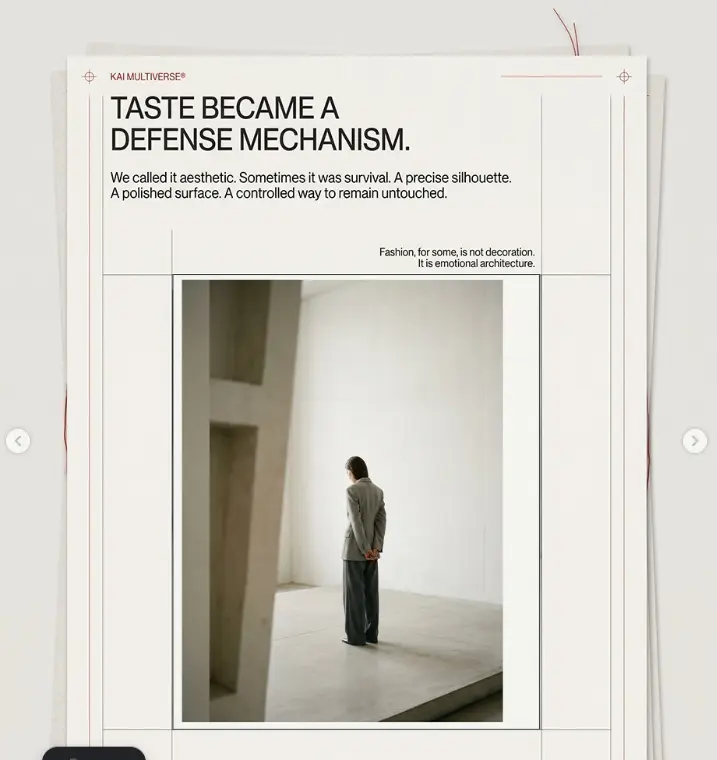
Sometimes aesthetic control is emotional architecture.
A human-behaviour file about polish, distance, protection and the visual systems people build to remain untouched.
When does refinement express preference, and when does it become a controlled distance from exposure?
HUMAN OBSERVATION
Sometimes the polished surface is not vanity. It is a boundary designed to keep contact predictable.
Layered paper, exact margins and quiet architectural photography create controlled distance. Fine red rules reveal the pressure holding that composure in place.
Why this file exists inside KAI.
The work begins where unpredictability makes control feel safer than exposure. Precision, polish and selection become ways to regulate contact with the outside world.
Aesthetic control is read as a possible protective strategy, not a pathology. The file respects the intelligence of the defense while asking what connection it may prevent.
The visual sequence.
Each artwork, with the idea and design decisions behind it.
Swipe to explore · Tap artwork for the original
Three rules hold this file together.
Air becomes protection
Large margins do not simply signal luxury; they stage the emotional distance at the centre of the file.
Polish carries tension
Clean paper and controlled photography are held just tightly enough to suggest that composure requires effort.
Red reveals the seam
Fine red lines expose the construction beneath the calm surface without turning the work into visual noise.
The idea becomes evidence through controlled applications.
01Essay plates↗
02Page architecture↗
03Image-as-armor study↗
04Archive captions↗
05Paper-object mockups↗
BOUNDARY
A human-behaviour and image-language study. It does not diagnose aesthetic preference, personality or protective behaviour.
STATUS
Ongoing archive file. The written premise and page system are established; the full sequence remains open.