
A three-part social-philosophy sequence inside the poster archive. It marks the point where KAI begins using visual systems to question the architecture of normality itself.
Poster / Published2026
The Social Malfunction
The outsider is not broken. Distance can reveal the architecture of the room.
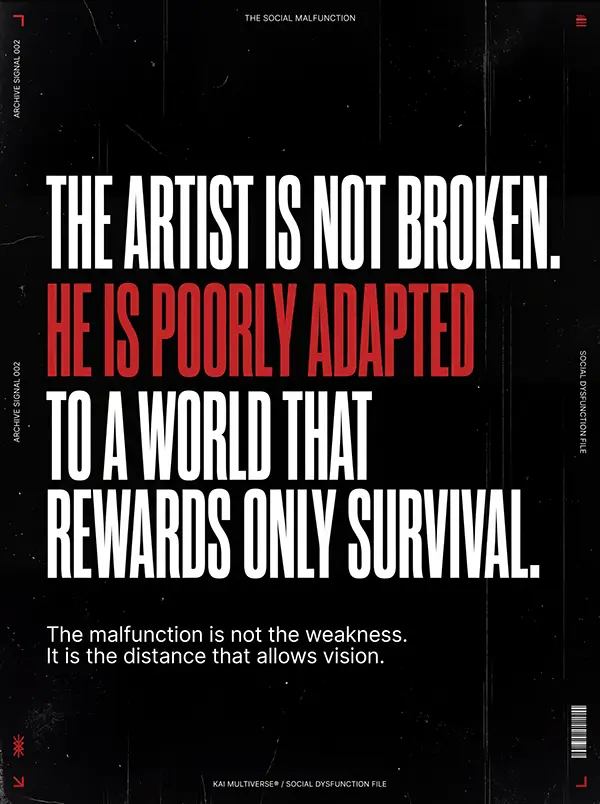
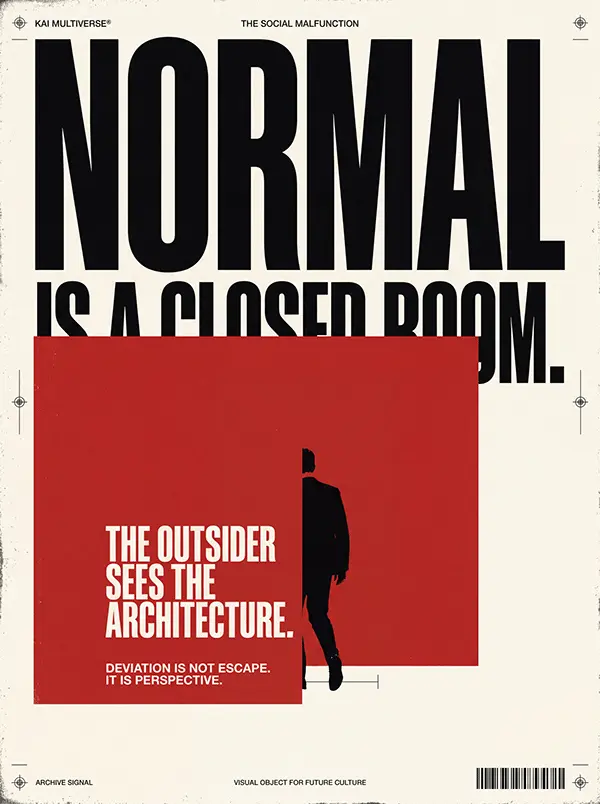
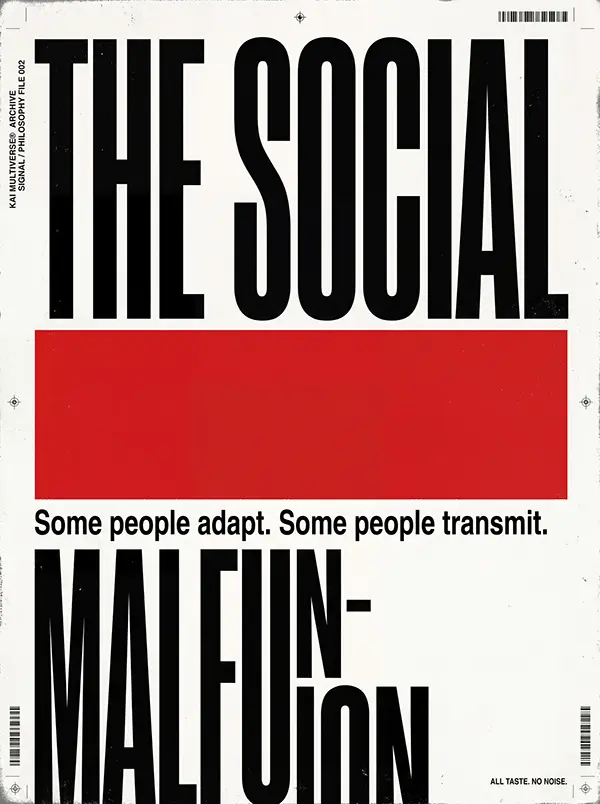
The outsider is not broken. Distance can reveal the architecture of the room.
A poster sequence about maladaptation, social pressure and the perceptual advantage of standing outside inherited norms.
What if the person who fails to adapt is not defective, but able to see the structure everyone else has learned to accept?
HUMAN OBSERVATION
Distance from a social system can create pain and perception at the same time. The file treats maladaptation as a cultural lens, not a clinical diagnosis.
Closed typographic rooms, hard black-and-red contrast and constrained silhouettes make normality feel architectural. Each poster opens a different exit: naming the pressure, locating the outsider and reframing distance as perspective.
Why this file exists inside KAI.
The work grows from the pressure to adapt to systems that reward survival, legibility and compliance while treating perceptual difference as personal failure.
Difference is protected from defect narratives without romanticizing alienation. Distance may reveal a structure, but exclusion and suffering are not presented as desirable conditions.
The visual sequence.
Each artwork, with the idea and design decisions behind it.
Swipe to explore · Tap artwork for the original
Three rules hold this file together.
Normal becomes a room
Large compressed type turns convention into physical enclosure so the viewer feels the pressure before reading the argument.
The outsider gains a plan view
The figure is deliberately smaller than the verbal architecture; distance becomes the position from which structure can be recognized.
Reframe without romanticizing pain
The language protects difference from defect narratives while refusing to claim that exclusion or suffering is desirable.
The idea becomes evidence through controlled applications.
01Three-poster sequence↗
02Social-philosophy copy↗
03Archive indexing↗
04Portrait-to-landscape cover system↗
05Digital carousel↗
BOUNDARY
This is an authorial poster inquiry into social pressure, difference and perception. It is not a medical claim, diagnosis or universal explanation of neurodivergence or mental health.
STATUS
Published as a three-poster social-philosophy sequence. Future plates may extend the inquiry without changing its core boundary.